NetBBS / Door games / Fair Winds

Cooperative balloon navigation

Fair Winds

Read the wind. Carry the post. Finish the map.

In development · not yet released
Play
Turn-based, one flying day per world day
World
Shared and cooperative
Built so far
Plan complete, build starting
Availability
Not yet released
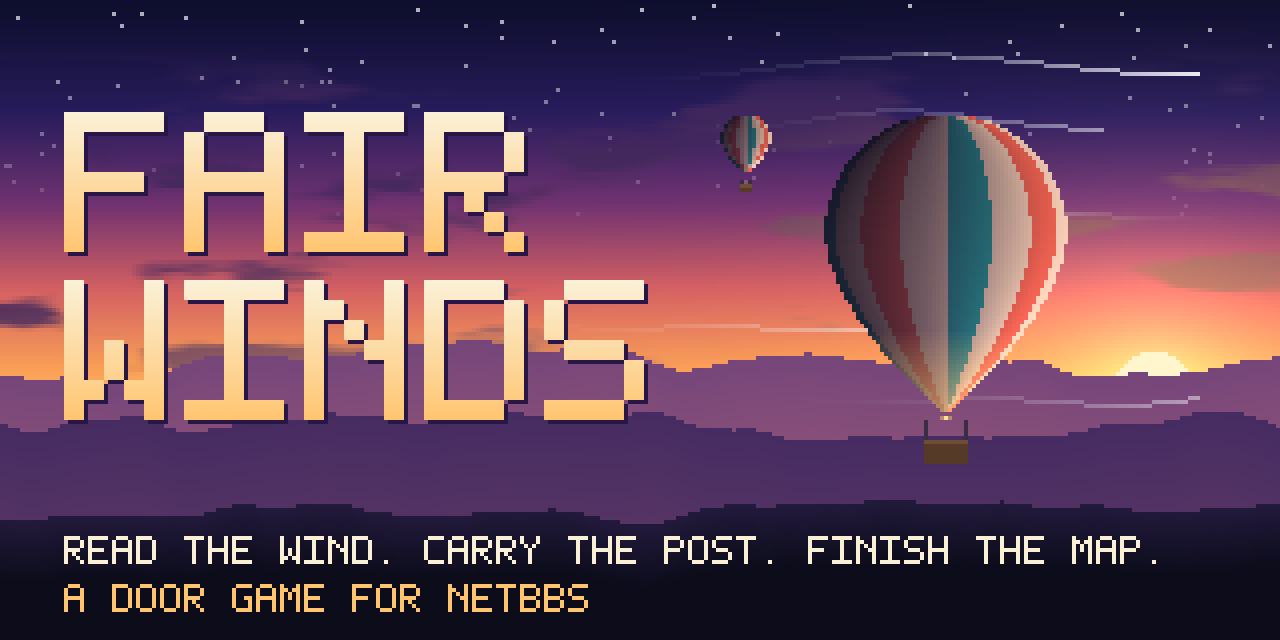
Concept art in pixel style: a striped red, cream and teal hot-air balloon drifting over purple hills at sunset, a smaller balloon behind it, under the title FAIR WINDS and the line: Read the wind. Carry the post. Finish the map. A door game for NetBBS.
Fair Winds. Read the wind. Carry the post. Finish the map. Project concept art, not a game screen.
The idea

A balloon cannot steer.

It can only climb or sink, and every altitude blows a different way. Each turn you see where the layers within reach would carry you, and you pick one. You carry the post across a continent that is unique to your BBS, starts out blank, and is charted by its callers together. Everyone flies the same weather, and the weather follows the calendar. At the centre of the continent stands the Gyre, a storm nobody has entered.

Steer by altitude

Six layers from the surface to the jet stream, each with its own wind. Mountains block the low ones, so a range has to be climbed over or threaded through a gap. Climbing burns fuel, sinking is free, and ballast is the emergency climb.

One weather for everyone

The weather is worked out from your node and the date. A low that parks over a mountain range stays there for every caller until it moves on, which gives a message board something to talk about.

No rivals

There is no combat and no way to harm another caller. Callers chart the map for each other, plant weather stations, raise mooring masts together and fly supplies to the stranded. Competition is in the standings only.

How it will play

From one turn to a whole continent.

Play is paced by the world’s calendar, never by the call. A flight is saved every turn, so a caller can hang up at any moment and carry on later, and hanging up rerolls nothing.

The turn

Fifteen minutes of flight. Look at where each layer would take you, then climb, sink or hold. The balloon drifts and the weather moves one step.

The flying day

Launch at dawn, be down by dusk: thirty to fifty turns. Deliver the post, chart blank map and land at a station or camp in the wild. Where you land is where tomorrow starts.

The season

Every 28 world days bring a weather regime and a goal for the whole node, such as opening a mountain pass with a chain of mooring masts. A long-distance race fills the last week.

The continent

Over months the chart grows from blank to complete, the almanac fills with named winds, and the ring of stations closes in on the Gyre.

Always something to fly

A new world day opens at the node’s midnight, and up to three wait, so a missed day costs nothing. Trials and the Daily Drift, one short course for the whole node, can be practised at any time.

No career ends

Run out of fuel and you come down where you are. Over land you walk out or wait for another caller to fly supplies in; over water the packet boat picks you up and the post is lost.

A world the callers build

Chart it together.

Flying over blank map fills it in for everyone, and the first caller to chart a peak, lake or pass names it. A station planted where you land sharpens the forecast around it for every caller, as long as someone keeps it supplied. Several callers flying materials in can raise a station into a mooring mast, with night landings, fuel and a post office, and that is how the frontier moves. Stranded callers show on the chart, and each station keeps a guestbook.

The game has to work for a single caller on a quiet node. Other callers make everything faster; they never gate it. Reaching the eye of the Gyre takes a late-game balloon, a community’s worth of stations and a real feel for spiral winds, and the first caller on a node to do it is recorded for good.
Any terminal

Built for wide truecolor, playable on 80 × 24.

Fair Winds is planned as one Python file with no dependencies beyond the standard library, a native NetBBS door like the four bundled games. A wide truecolor terminal is a real advantage, and a narrow one still plays:

  • 80 × 24, sixteen colours. The whole game: a shaded character map, wind as line glyphs and the layers as a table.
  • 132 × 40, truecolor. A relief map in half blocks, animated wind, the sky and full-screen scenes.
  • 168 × 46 and wider. A forecast timeline, the callers in the air, the cargo and a longer log.

Play never depends on colour alone: wind always has a direction glyph, a compass point and a number, and callers who switch motion off get still wind streaks.

The build

From the wind to the first release.

The build is planned in seven phases. The first is done: the product, the host contract and the specification are settled. The rest are:

  • The wind and the turn. The world generator, the weather and a plain flight with no art. The phase ends in a play-test of whether choosing a layer is fun for forty turns, and if it is not, the turn is reworked before any art is drawn.
  • Beautiful flight. The relief map, animated wind, the sounding panel and the scenes.
  • Career. The world database and pilot records, the calendar, towns and the post, the licence and the balloon.
  • The shared world. Charting and names, stations and masts, stranding, rescue and guestbooks.
  • Reasons to return. The chart, the almanac, the Daily Drift, trials, wonders, seasons and the Gyre.
  • Ready to ship. Standings, and game events, storm warnings and a weekly Gazette the door can post once a SysOp switches its outbound hook on; SysOp tools, acceptance on a real NetBBS host, and the release.

The build plan lists every step, and the open issues show what is being worked on.