Two layers, one world
Walk the streets in real time with every other caller on the node, or jack in and run the Lattice while your body waits upstairs. What you do in the network changes the street, and the reverse.
NetBBS / Door games / Blacksite
Cyberpunk multiplayer RPGThe city was built to keep something in. Nobody remembers what.
In development · not yet released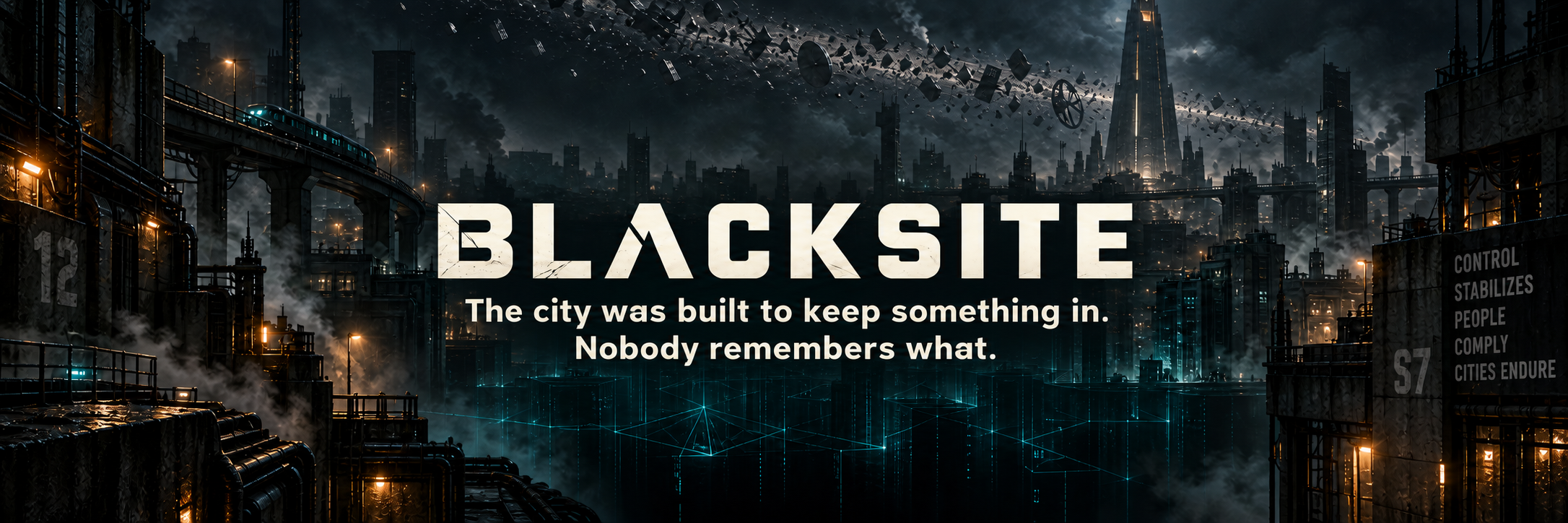
Karst is a city of four million on a limestone plateau, sealed off since the day the orbital network tore itself apart. The sky is a glittering ring of debris, and Ring-fall is loud. The city grew around Site Zero, a classified installation sunk deep into the rock, and everyone lives on top of a sealed hole whose purpose was forgotten with the people who knew it. Underneath the streets runs the Lattice, the city's surviving network, where something has been very patiently running the numbers.
You are a Wake: a freshly decanted clone with no memories, on a ninety-day lease from Sablier Biomedical, cheap labour for whichever faction gets to you first. Eight factions run the city: Halvard, Sablier, Kestrel, the Wardens, the Ninefold Choir, Red Sable, the Unmoored and the Ferrymen. The game is about what you become, and how far down you are willing to go.
Walk the streets in real time with every other caller on the node, or jack in and run the Lattice while your body waits upstairs. What you do in the network changes the street, and the reverse.
The city is tired and funny about it. Nobody says “hacker”; they say runner. Brand names are a language: Sablier owns your body, Kestrel owns your commute, Halvard owns the sky above the Spire.
The Blacksite has begun to exhale: warm air and old data rising up sealed shafts. Each season will open one more level, and the city's opening question will matter more.
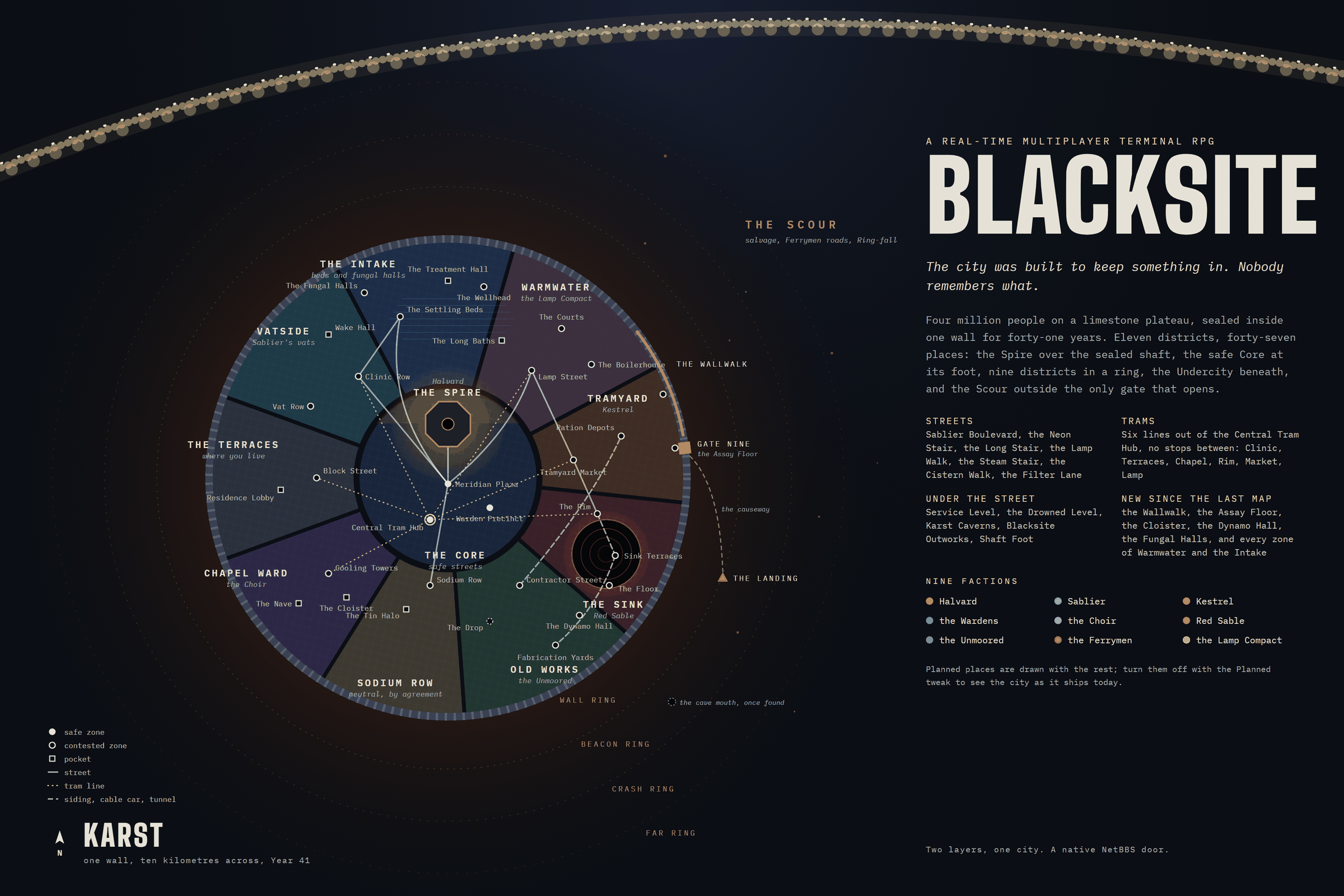
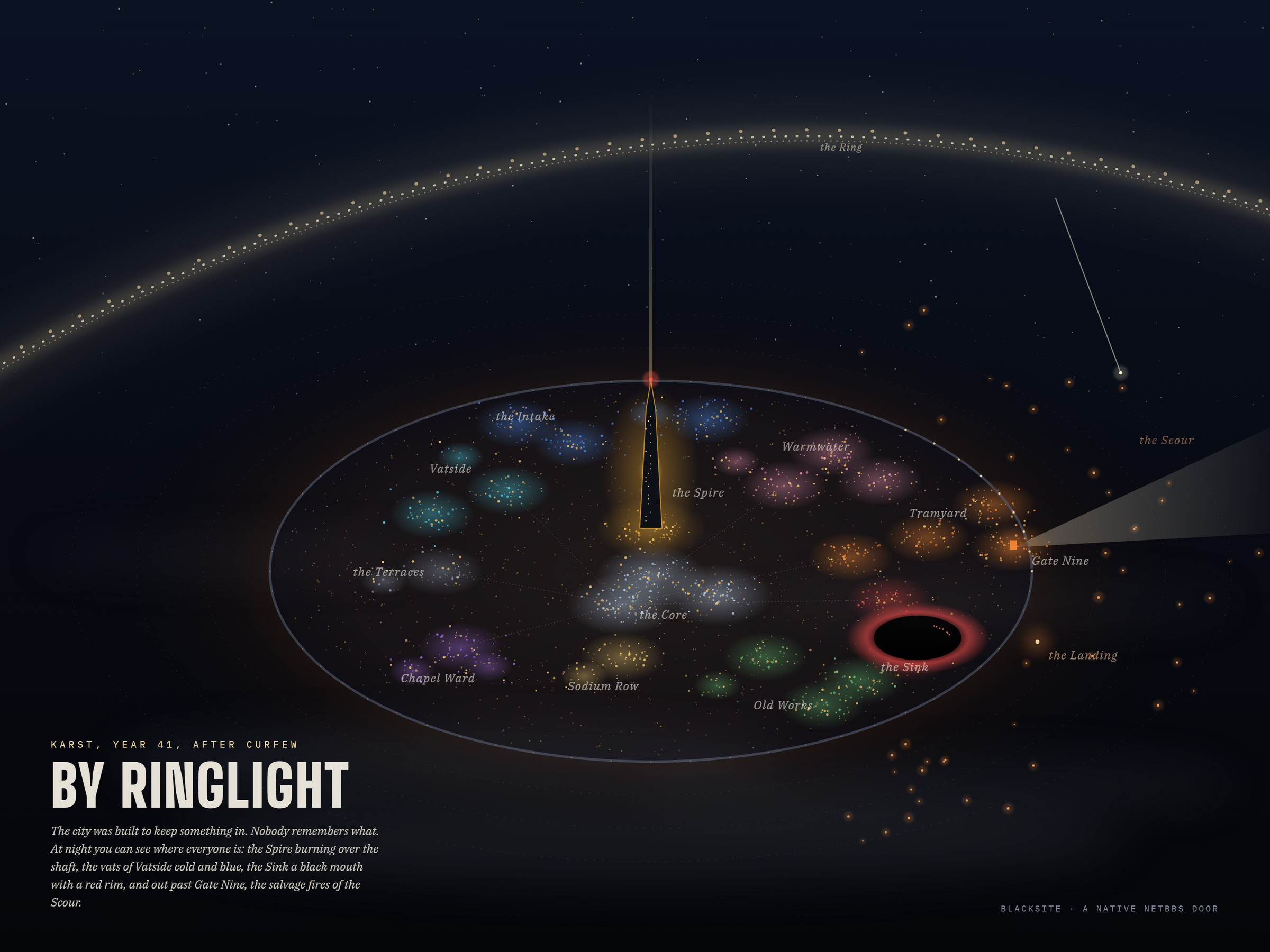
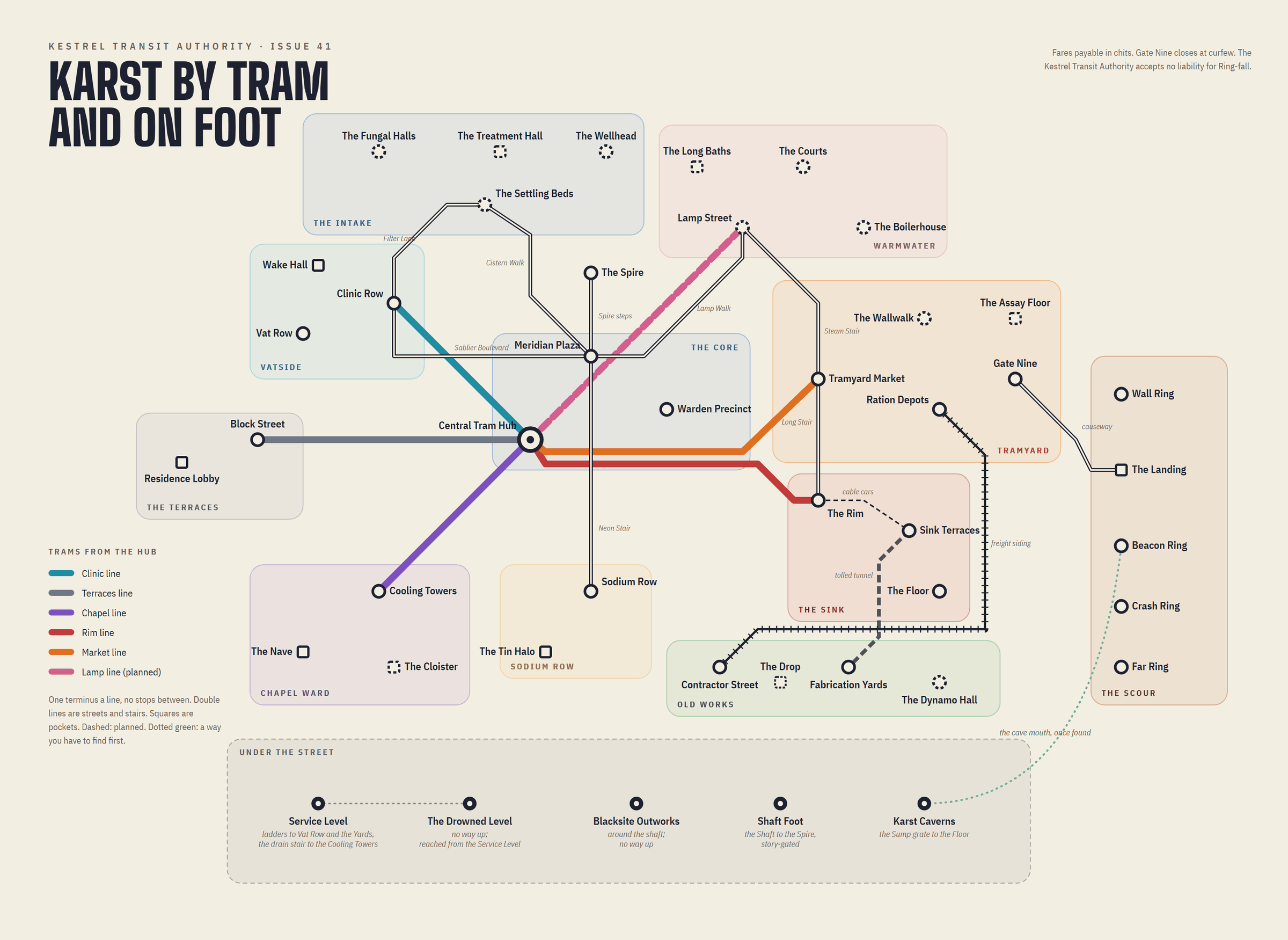
These three maps of Karst come from the game’s design work. They are illustrations, not game screens: the in-game City Map is still planned. They draw planned places alongside the ones already built, and details may change before the first release.
These two screens are design targets from the game’s presentation work, not screenshots. They show how Blacksite is planned to look on a 132 × 50 terminal in truecolor, over one evening: the bar you sit down in, and the Lattice you go down into from its chair. Some of what they show is still to be built, including the painted view inside the bar. The Lattice already runs with the same layout, drawn more plainly. The soft glow around the lights is added for this page; a terminal draws the same cells without it. Details may change before the first release.
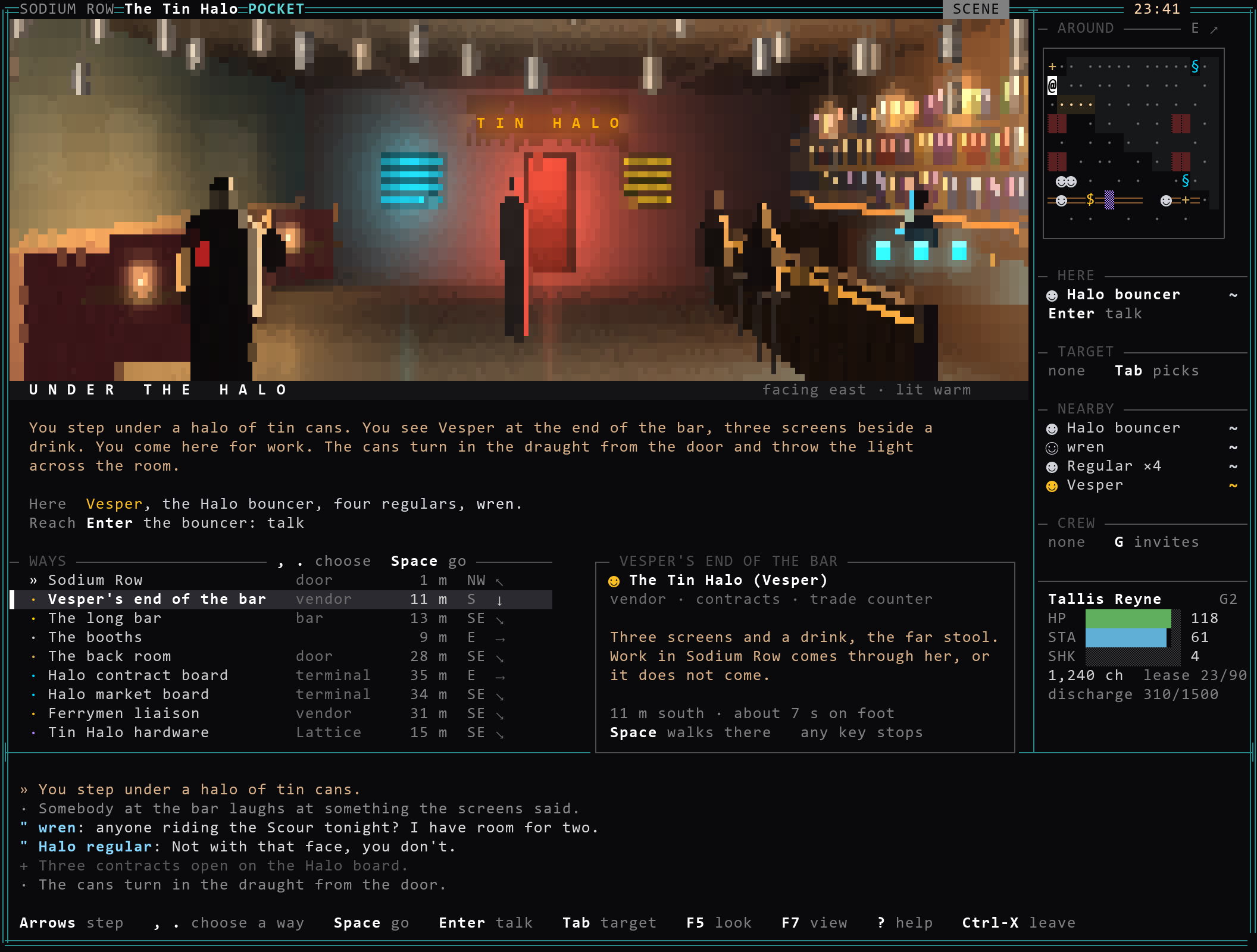
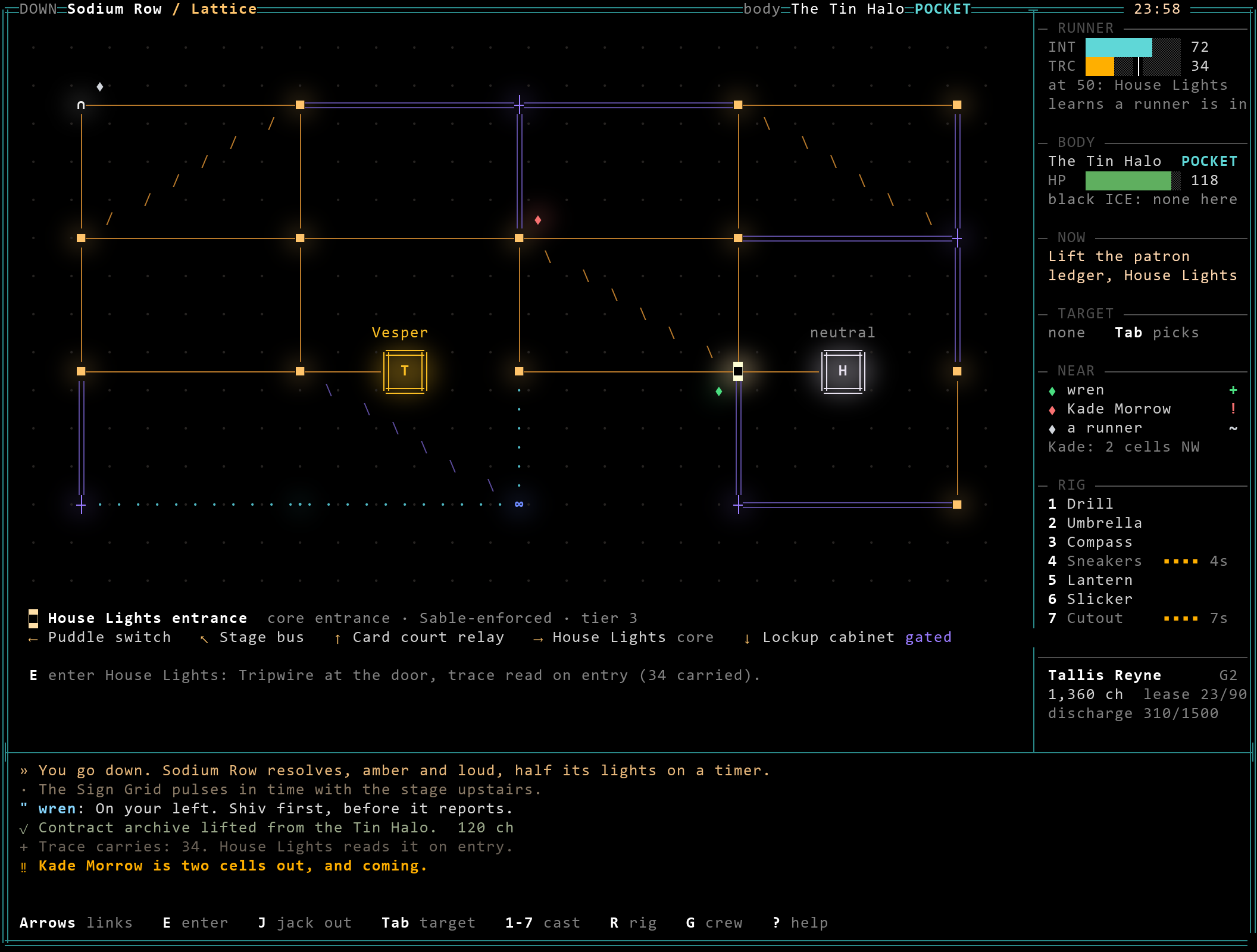
“The light's cheap and it stays on,” says Dr. Ilse Vantongeren, who runs the Wake Hall and was decanted there herself, a long time ago. You choose a template: Hardline for the front of a fight, Ghost for a rig-ready nervous system, Cantor for implants the Ninefold Choir recognises on sight, Operator for drones, trade and people. You pick a name. Your BBS handle stays visible beside it.
Vantongeren hands out the factions' recruiter cards without preference; they all resent that. Take one, or don't: it is an introduction, not a contract. Then there is a drone in the corridor that has been malfunctioning since Tuesday. It teaches the rhythm of a fight: Tab to target, F to raise your weapon, a two-second warning, F again to fire. Its shots cannot kill you. After that comes a terminal, and the Lattice.
Outside the Wake door is Clinic Row, the first contested street. Up Sablier Boulevard is Meridian Plaza, and beyond it the tram hub, the Wardens' precinct, the Terraces and Sodium Row, where Vesper brokers contracts at the Tin Halo. Trams leave on fixed 90-second boundaries. Ninety days, or grade 5 earned early through completed work, turn the lease into personhood.
Blacksite is built in 33 steps, and each caller-facing step is tested through a real NetBBS door at 80 × 24 and a larger terminal. The first 24 are done: the foundation, the street, the Lattice, progression, and factions and conflict, plus the world events.
Ten connected zones across Vatside, the Core, Sodium Row and the Terraces, with scheduled trams and safe, contested and pocket zones. Walls block sight, and remembered streets stay on the map, dimmed.
Say carries 20 tiles, shout fills the zone, and whispers find anyone online. There are emotes, crew and faction chat, a sitrep of who is where, and ignore and report.
A new threat gets a two-second warning. A downed body can be picked up by a friend; otherwise Sablier decants you again, with a bill and a little Fade. Gear you did not secure stays in a cache for five minutes.
Residents, couriers and guards go about their business. Try to attack someone in a safe zone and the Wardens warn you within two seconds, send responders and remember you for ten minutes.
Eleven district sectors, a helpless body left behind, 35 programs and 23 kinds of ICE with names like Sandman, Suture, Glasshouse and Kiln. Trace runs while you stay, black ICE reaches back up the link, and the Silt waits underneath.
A runner in a core can flip its controls: a door, a camera, a tram held at the platform. A crew at the hardware can cut a core's power instead, and the runner inside feels the floor go.
Thirty grades and twelve skill lines that rise by use. Implants with surgery risk, drugs with dependency clocks, owned drones, salvage, schematics and fabricated gear of varying quality.
Standing with eight factions, membership and ranks, and the Marked rule for anyone who shoots the wrong person. Crews of two to five share chat, rewards and experience. Relays are taken by holding them while a runner hacks their core.
Contracts from Vesper and the factions, solo or with a crew, with an evidence journal for the jobs that matter. A local market and bounties. Five world events (Ring-fall, Curfew, Choir Surge, Exhale and Convoy) are forecast before they arrive.
Several systems above are finished and tested with clearly labelled test fixtures, because the places they belong to are not in the playable city yet: apartments in the Terraces, workshops in Old Works, salvage rings out in the Scour, and most of the sixteen relay sites. The playable city is still the ten-zone hub. The next steps are:
The build roadmap lists every step, and the open issues show what is being worked on.